
RFID Card by Nialabs
Security
AI-Anti Spoofing
Reports
Real-time Syncing
About RFID Cards
What is an RFID card?
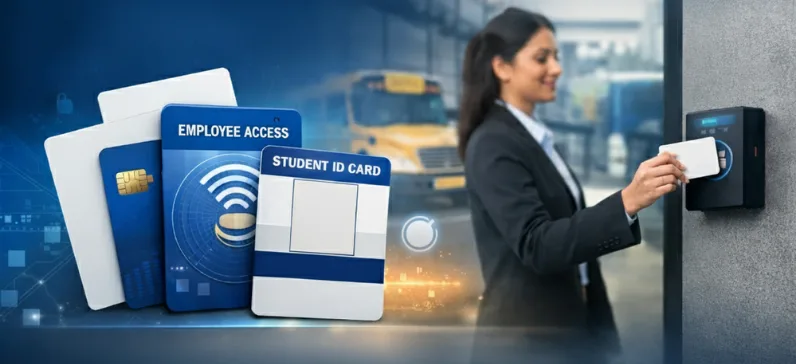
An RFID (Radio Frequency Identification) card is a contactless smart card embedded with a microchip and an antenna. The embedded microchip stores data and supports encryption. The RFID card communicates with reader devices and performs functions such as access control, identity verification, cashless payments, inventory management, etc.
Unlike barcodes, RFID cards do not need to be seen to be read. They can be read through wallets, pockets, or purses.
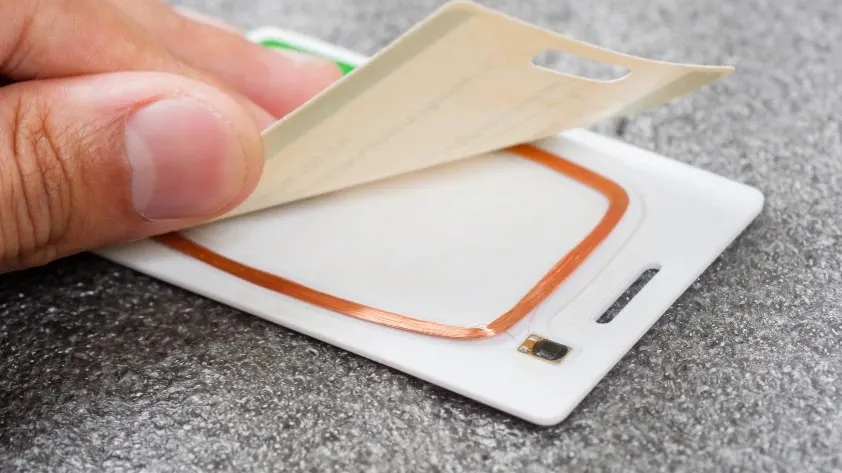
Chip/IC: Stores a unique ID and sometimes additional data.
Antenna: Copper/aluminium coil that captures radio signals and sends data back.
Substrate & PVC body: The physical card body that you can print school/office branding on.
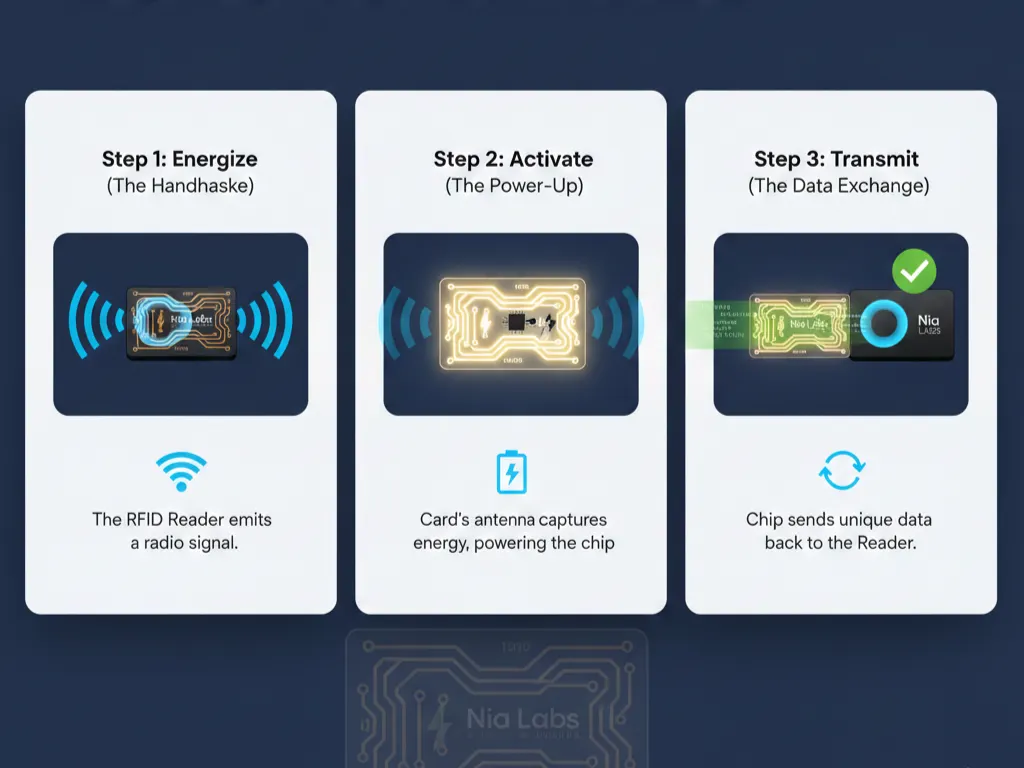
How Does an RFID Card Work?
- 1
The RFID reader emits radio waves.
- 2
The RFID card enters the reader’s range.
- 3
The card’s chip is powered (passive cards).
- 4
The card transmits its unique ID.
- 5
The system verifies and records the data.
Types of RFID Cards
Different RFID card technologies designed for specific security and range requirements.
Passive Cards
No battery. Powered by the reader. Cheaper, thinner, lasts forever. (99% of cards are this).
Active Cards
Have a battery. Transmits signal over 100m. Used for tracking people in dangerous zones (e.g., oil rigs).
Read-Only (RO)
Data is written once by the manufacturer (like a unique ID number) and cannot be changed.
Read-Write (RW)
You can rewrite data on the card (e.g., updating a user's access level or subway balance).
RFID Cards vs Other Identification Methods
Understand why RFID is the preferred choice for modern institutions.
| Feature | RFID Cards | Barcode / QR | Manual Entry |
|---|---|---|---|
| Read Speed | Milliseconds | Seconds | Minutes |
| Line of Sight | Not Required | Required | Required |
| Data Capacity | High (Encrypted) | Low | Minimal |
| Durability | Very High | Low (Paper/Print) | N/A |
| Security | High (Cloning resistant) | Low (Easy to copy) | Low |
The Technical Core:
Frequency Categories
Low Frequency (LF) - 125 kHz
Short read range (1-2 cm). Used for basic access control and animal tracking. Durable but limited data.
High Frequency (HF) - 13.56 MHz
Read range up to 10 cm. Standard for attendance, smart cards (MIFARE), and mobile-linked systems.
Ultra-High Frequency (UHF) - 860-960 MHz
Long read range (3-10m+). Ideal for vehicle tracking, parking, and logistics management.
Functions & Features of RFID Cards
Identification and inventory: Uniquely identifies a person/asset in milliseconds.
Access control: Opens doors, gates, and boom barriers when authorised.
Attendance logging: Captures IN/OUT time when tapped on attendance machines.
Cashless payments: Stores wallet balance or links to account for canteen, vending, and events.
Applications of RFID Cards
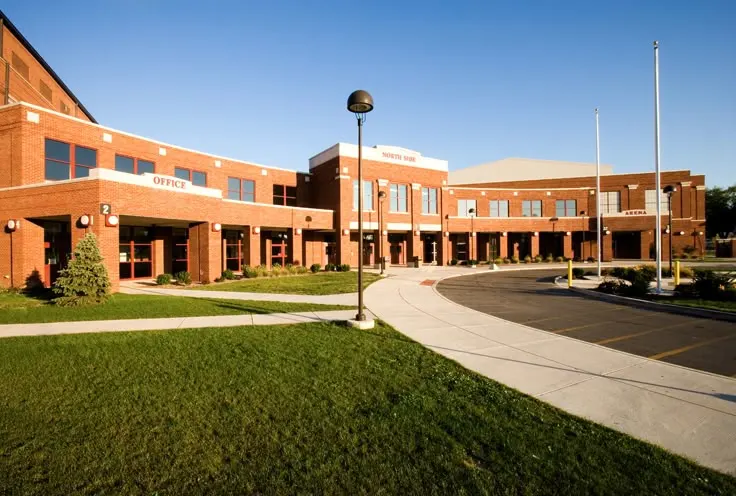
Schools & Colleges
Student ID + smart attendance at the gate/class. Library automation, cashless canteen, and bus tracking.

Corporate Offices & IT Parks
Employee ID, access to different zones, and visitor badges. Attendance integration with HRMS/payroll.

Manufacturing & Warehouses
Worker attendance, restricted area access. Asset and inventory tracking with RFID cards/tags.

Residential & Parking
Vehicle RFID cards/stickers for gate automation. Clubhouse, gym, and swimming pool access.
AI Technology
Real-time Recognition
Premium Choice
Why Choose Nialabs RFID Cards?
Premium quality chips
Custom printing & branding
Compatible with all Nialabs readers
Bulk supply across India
Affordable pricing
Looking to Buy RFID Cards
For Your Organization?
Get expert guidance, best pricing, and fast delivery.
- Premium quality chips
- Long-lasting & durable
- Custom logo printing